
Cosmetics Usage Period — How to Read the Manufacturing Date and Post-Opening Period
Cosmetics usage periods are broadly divided into two types of indication. One is the 'expiration/months from date of manufacture' that applies while unopened, and the other is the 'Period After Opening (PAO)' that starts fresh the moment the lid is opened. The principle is to follow whichever standard arrives first, and depending on storage conditions, actual stability may come sooner than the indicated period.
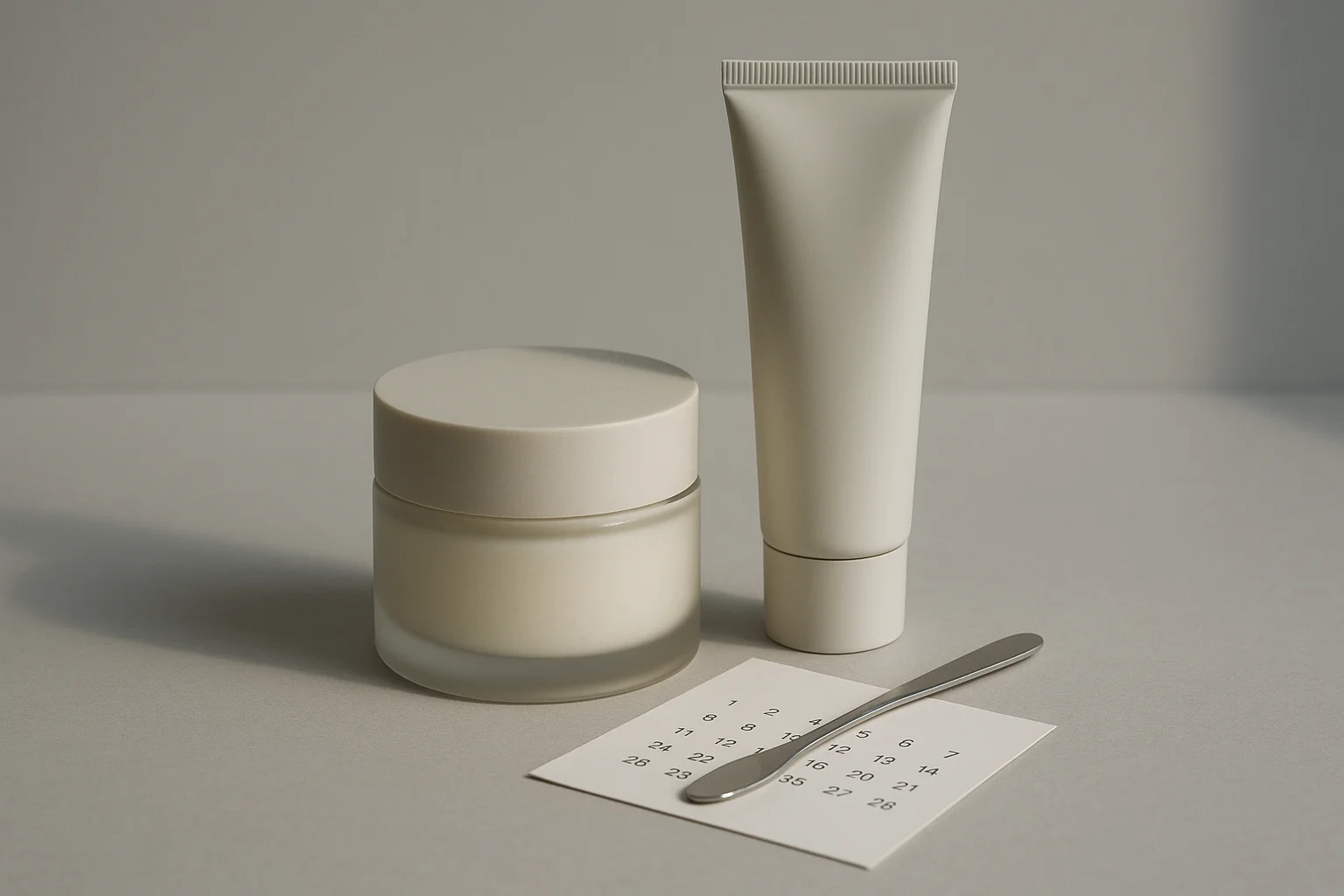
While tidying up a vanity drawer, there comes a moment when you wonder, 'Can I still use this cream?' Even looking at the numbers and symbols printed somewhere on the packaging, it's easy to get confused about what they actually mean.
To get straight to the point, cosmetics have two different time concepts that coexist. One is the 'expiration date (or number of months from the manufacturing date)' based on the unopened state, and the other is the 'period after opening,' which starts counting anew from the moment the lid is first opened.
- 1Right after purchaseCheck the batch number and expiration date label
- 2At the moment of openingRecord the opening date, check the PAO symbol
- 3Midway through useCheck for changes in texture, scent, or color
- 4Later in usePlan for replacement as the labeled period approaches
Why do two separate standards exist?
Since unopened cosmetics have almost no contact with air, the rate at which ingredients deteriorate is slow. That's why manufacturers set a label such as 'expiration date' or 'usable up to OO months from the manufacturing date' based on this unopened state.
But once the lid is opened, the situation changes. Fingertips or spatulas come into contact with the contents, and exposure to oxygen, moisture, and microorganisms in the air increases in frequency. As this exposure accumulates, the stability of the ingredients can gradually change, which is why a separate standard is needed to manage the period after opening.
This second standard is indicated by the symbol shaped like an open jar drawn on the container, and the number followed by M (Month) inside it means 'use is recommended for up to this many months after opening.'
| Category | Reference point | Where it's usually labeled |
|---|---|---|
| Expiration date / based on manufacturing date | Manufacturing date (assuming unopened state) | Outer packaging or bottom of the container |
| Period after opening (PAO) | The day the lid is first opened | Open jar symbol and number (M) on the container |
Why the post-opening standard differs by formulation
Even within the same brand and same line, the recommended period after opening is often displayed differently depending on the formulation. This is because the viscosity, moisture content, and container structure (pump type, tube type, jar type, etc.) of the formulation affect the degree to which the contents are exposed to air.
For example, jar-type creams where you dip your fingers directly in tend to have relatively more contact with the outside compared to pump-type products, so it may help to develop the habit of using a clean spatula each time. Conversely, sealed pumps or tube containers, where the contents have less surface area exposed to outside air, are relatively easier to manage.
However, this is only a general tendency—the exact usable period after opening should always be checked against the label indicated on the actual product container.
Checkpoints to review by time period
Right after purchase, it's good to first check the outer packaging or the bottom of the container for the batch number along with the expiration date or the period of usability from the date of manufacture.
At the moment of opening, it's useful to make a habit of noting that date separately. Check the period-after-opening symbol on the container (e.g., 12M, 24M), and based on that number, writing down the opening date and the expected expiration point in a diary or smartphone memo makes managing it much easier.
In the middle of use, it's good to check whether there are any changes in texture, scent, or color compared to usual. If separation, an unfamiliar scent, or a noticeably changed color is detected, it's safer to stop using the product and reassess its condition even if the indicated period has not yet passed.
In the later stage of use, as you approach the indicated period, planning ahead for when to switch to a new product can reduce the chance of continuing to use it during an ambiguous period.
The effect of storage environment on the usable period
The period after opening is calculated based on the assumption of a general storage environment. In other words, if the product has been kept in extreme conditions—such as a sunlit windowsill, a bathroom with large swings in humidity and temperature, or inside a car in summer—the actual stability may be shortened compared to the indicated period.
Keeping cosmetics in a cool, dry place away from direct sunlight, and developing the habit of closing the lid immediately after use to maintain a sealed state, helps keep the product within its indicated usable period.
Using a spatula or pump to minimize direct contact with the contents, rather than dipping your hands in directly, is also a practical way to maintain the condition of the product after opening for longer.
Why the usable period matters especially in elasticity and wrinkle care routines
The management of the usable period becomes even more important for functional cosmetics used consistently for elasticity or wrinkle improvement. Since such products are generally designed to be used daily over a long period, continuing to use them past the indicated period may make it difficult to fully enjoy the original texture or formulation stability that was initially expected.
In particular, for formulations with a high proportion of oil and moisturizing ingredients, such as rich-type creams used in the finishing step, the balance among ingredients may shift from its original state as time passes after opening. So if you're planning a consistent routine, it can also help to estimate in advance how long it will take to use up a container versus the period after opening, and adjust your usage amount accordingly.
The final step—which cream should you finish with?
에르쯔틴 리제너레이티브 실트 크림 also has a period-after-opening symbol displayed somewhere on the container. Since it's a rich-type formulation, adjusting the daily amount appropriately, recording the opening date, and making it a habit to use it up within the indicated period can also help you keep up a consistent elasticity and wrinkle care routine.
Frequently asked questions
- Where can I find the period-after-opening label?
- It's usually marked on the bottom or side of the container with a symbol shaped like an open jar with its lid off, along with a number and M (Month). For example, if it says 12M, it means the product is recommended to be used within 12 months after opening. Since the label position can vary by product or line, it's a good idea to check the entire container.
- Is it okay to use a cream past its expiration date?
- Products that have passed their labeled expiration date or period-after-opening are not recommended for use, as the stability of the ingredients may no longer be guaranteed. In particular, if you notice any unusual change in scent, color, or texture compared to normal, it's safer to stop using it even if some time remains, and to consult a specialist if you experience any adverse skin reaction.
- How should creams be stored?
- The basic rule is to avoid direct sunlight and keep the product in a cool place without large changes in temperature or humidity. After use, close the lid right away to maintain an airtight seal, and if possible, use a spatula instead of your fingers to reduce contact with the contents — this helps preserve stability throughout the entire usage period.
- What does a label saying '30 months from the manufacturing date' mean?
- 30 months from the manufacturing date refers to the usable period based on the unopened state. In other words, if stored unopened, quality is maintained up to this period, but if the lid is opened before that time, it's important to remember that the separately labeled period-after-opening standard applies from that point on as well.
Reviewed by 아비쥬의원 의료진. (September 2, 2026)
Related products
 리제너레이티브 실트 크림Buy
주름 개선 기능성 화장품 · 탄력과 장벽을 함께 보는 리치 크림