
Ingredients That Pair Well with Olive Oil — Reading Combination Design Through the Full Ingredient List
Olive oil is an oil-based ingredient that forms a film on the skin's surface to slow moisture loss, but it does not by itself play a role in refining elasticity or texture. Checking whether olive oil appears alongside barrier lipid ingredients (ceramides, cholesterol, fatty acids), soothing ingredients (centella asiatica derivatives), or elasticity-care ingredients (adenosine, peptides) in the full ingredient list makes it possible to more accurately read the design intent of a cream.
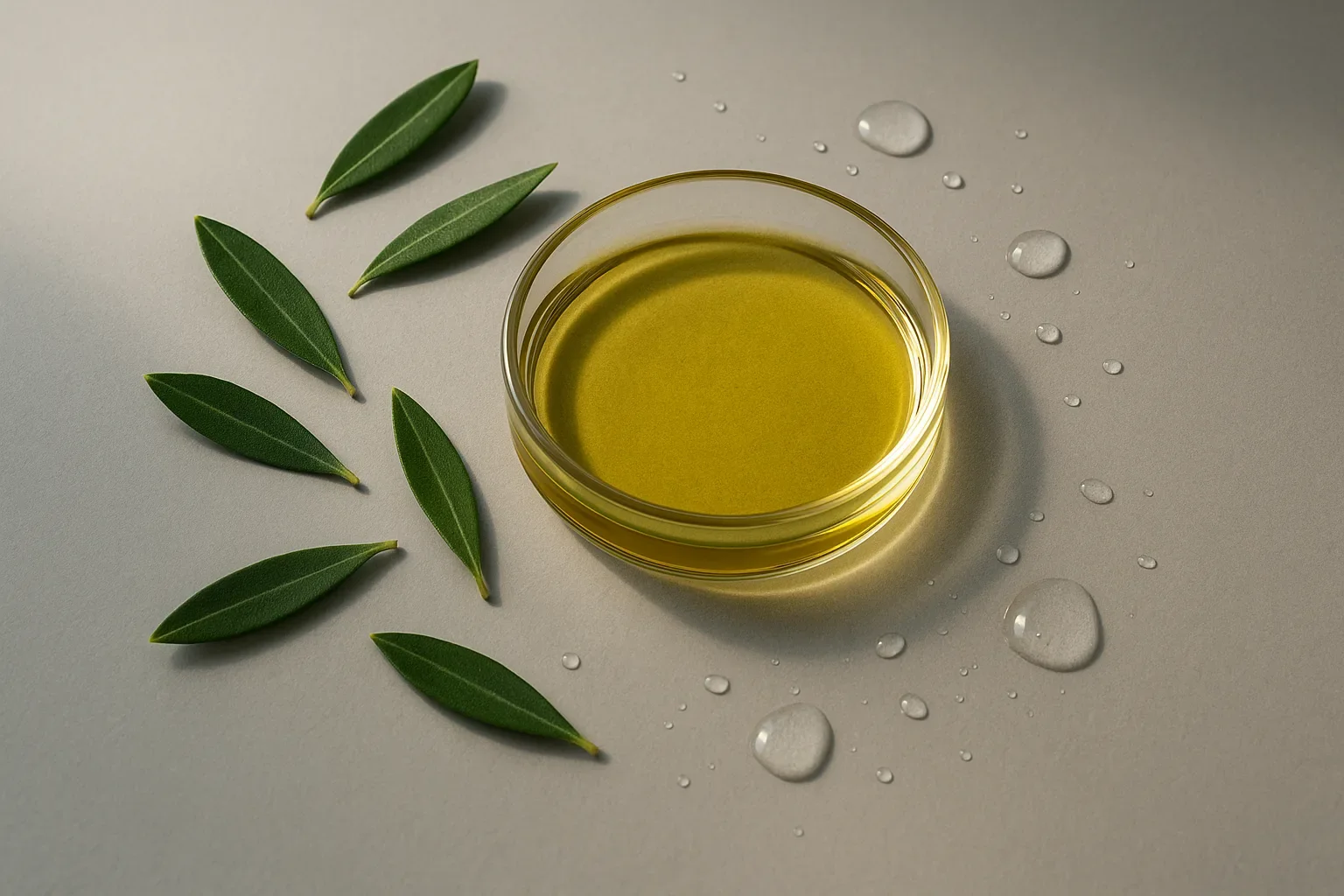
The judgment that 'it contains olive oil, so it must be a moisturizing cream' is only half correct. Olive oil forms a thin oil film on the skin's surface that slows the rate at which moisture evaporates. However, what actually happens beneath the moisture this film protects is determined by the other ingredients placed alongside it. This is why, when reading the full ingredient list, you shouldn't look at olive oil alone, but should also examine which ingredients are listed before and after it.
What Olive Oil Does and Doesn't Do
Since olive oil is a lipid-soluble ingredient, it doesn't directly bind with moisture on the skin's surface. Instead, it remains on the surface acting more like a 'lid' that slows moisture from escaping into the air. This action itself is useful, but if it stops there, the skin can remain in a state where 'the surface feels moist, but the inside stays the same.'
So when checking the full ingredient list, it's worth developing the habit of checking whether ingredients that hold moisture in place (glycerin, trehalose, betaine, etc.) or lipid-based ingredients that form the skin barrier (ceramides, cholesterol, fatty acids, etc.) are present alongside olive oil. The combination can be considered complete when you have the moisture that olive oil seals in, the ingredients that hold that moisture in place, and the lipid ingredients that make up the barrier, all together.
Checking the combination design — what matters is which ingredients it's paired with
Full ingredient lists are arranged in descending order of content, but lower-content ingredients are often clustered closely together, making it hard to judge proportion by order alone. So it's more useful for understanding the actual design to look at 'which group of ingredients this ingredient appears with' rather than 'where this ingredient ranks in the order.'
For example, if olive oil appears together with other oil ingredients like squalane, shea butter, and argan kernel oil, this combination can be seen as designed to maintain moisture by layering a rich oil film. If barrier lipid ingredients like ceramides, cholesterol, and palmitic acid are added on top of that, it can be interpreted as having a layer that cares for the skin's own barrier structure beneath the oil film.
On the other hand, if olive oil stands out alone with few other lipid ingredients, the product is likely designed mainly for surface-level moisturizing. Neither design is inherently bad, but if skin concerns go beyond dryness to include elasticity or texture, the former design addresses a broader range than the latter.
| Ingredient Group | Representative Ingredients | Role |
|---|---|---|
| Oil Film Formation | Olive Oil, Squalane, Shea Butter, Argan Kernel Oil | Forms an oil film that slows moisture evaporation |
| Barrier Lipid Composition | Ceramide NP, Cholesterol, Palmitic Acid | Belongs to the same lipid family that makes up the skin barrier |
| Soothing Group | Asiaticoside, Madecassic Acid, Asiatic Acid | Soothing skin care |
| Elasticity Care Purpose | Adenosine, 3 types of Peptides | Wrinkle-improving functional and elasticity care design |
Combinations to check depending on the stage of skin concern
If simple dryness is the concern, the combination of olive oil with moisture-retaining ingredients (glycerin, trehalose) alone may reduce immediate tightness. However, if dryness has persisted for a long time along with fine lines or reduced elasticity, the next step is to check whether ingredients aimed at elasticity care are present alongside oil ingredients like olive oil.
During seasonal changes or times when skin becomes sensitive due to heating or cooling, it's worth checking whether centella asiatica-derived ingredients intended for soothing (asiaticoside, madecassic acid, asiatic acid, etc.) are present alongside olive oil. If the structure has oil protecting the surface while soothing ingredients manage irritation, this combination can be considered usable without issue even during sensitive periods.
Application order and care routine
Products containing olive oil are generally rich types with an oily feel, so in terms of order, it's correct to use them at the final step after applying lighter, moisture-focused formulas like toners and ampoules first. This is because applying oil ingredients first can block the absorption of moisture ingredients applied afterward.
Rather than in the morning, adjusting your routine to use a rich-type cream in the finishing step in the evening or on especially dry days can help the oil film, moisture-retaining ingredients, and barrier lipid ingredients perform their roles in the right order. However, since responses to oils vary from person to person, if trouble or breakouts occur, it is safer to reduce the amount used or consult a specialist.
An Actual Combination Case Confirmed Through Full Ingredient List Design
Taking the full ingredient list of ARZTIN Regenerative Cilt Cream as an example, olive oil is placed alongside squalane, shea butter, and argan kernel oil to form the oil film; ceramide NP, cholesterol, and palmitic acid are placed to form the barrier lipids; and adenosine, a functional ingredient recognized for wrinkle improvement, along with three types of peptides for elasticity care, are placed in separate positions. Checking this structure, in which roles are divided by ingredient group, allows for a much more concrete understanding of the formulation's intent than judging a product by a single oil ingredient alone.
This cream is a rich-type formulation meant to be used as the final step, and as outlined earlier, it is best suited for use after lighter formulations. The actual experience may vary depending on individual skin condition and season, and if any adverse reaction occurs, use should be stopped and a specialist consulted.
What Cream Should You Finish With in the Last Step?
Once you develop the habit of checking how ingredient groups are arranged in the full ingredient list, you may naturally become curious about whether this combination actually leads to real skin changes. In a human application test conducted on adult women aged 30 to 59, ARZTIN Regenerative Cilt Cream was reported to improve skin elasticity recovery and cheek firmness immediately after a single use (individual differences exist; see table below).
사용 전과 비교해 사용 직후 통계적으로 유의하게 개선됐습니다. 개선율(%)은 사용 전 대비 변화량의 비율이며(|사용 후−사용 전|÷사용 전×100), 개인차가 있을 수 있습니다.
출처 P&K 피부임상연구센타 인체적용시험 결과보고서 (PNK-24610-RD1R2, 2024)
사용 전과 비교해 사용 직후 통계적으로 유의하게 개선됐습니다. 개선율(%)은 사용 전 대비 변화량의 비율이며(|사용 후−사용 전|÷사용 전×100), 개인차가 있을 수 있습니다.
출처 P&K 피부임상연구센타 인체적용시험 결과보고서 (PNK-24610-RD1R2, 2024)
Frequently asked questions
- Does using olive oil together with ceramides improve the effect?
- Olive oil slows moisture evaporation by forming an oil film, while ceramides belong to the same lipid family that makes up the skin barrier. When both are present together, it can be seen as a design that considers surface hydration and barrier care at the same time, but the actual experience may vary depending on skin condition and environment.
- If olive oil appears near the end of the ingredient list, does that mean it's present in a small amount?
- Ingredients above a certain concentration are listed in order of concentration, but for lower-concentration ingredients, the listing order can vary, so it's difficult to determine proportion based on order alone. Rather than focusing on order, it's more useful to look at which ingredient groups it's placed alongside to understand the design.
- Is it okay to use a cream containing olive oil in the morning?
- It's fine to use, but if it's a rich, oily-feeling type, it may suit better being used in the evening or as a finishing step on especially dry days. If using it in the morning, you could try applying a thin layer over a lighter formula.
- What should I do if breakouts occur after using a product containing olive oil?
- Stop using the product and monitor your skin condition, but if symptoms persist or worsen, it's safer to consult a dermatologist or other specialist.
Related products
 리제너레이티브 실트 크림Buy
Anti-wrinkle functional cosmetic · A rich cream that addresses both elasticity and barrier care
- 리제너레이티브 실트 크림Buy
Anti-wrinkle functional cosmetic · A rich cream that addresses both elasticity and barrier care
- 리제너레이티브 실트 크림Buy
Anti-wrinkle functional cosmetic · A rich cream that addresses both elasticity and barrier care
- 리제너레이티브 실트 크림Buy
Anti-wrinkle functional cosmetic · A rich cream that addresses both elasticity and barrier care
- 리제너레이티브 실트 크림Buy
Anti-wrinkle functional cosmetic · A rich cream that addresses both elasticity and barrier care