
Which Skin Type Suits Shea Butter — Ingredient List Design Matters More Than Oiliness
Shea butter isn't an ingredient suited to a specific skin type—rather, how it feels depends on the ingredients it's designed alongside. It may help dry, tight-feeling skin or skin that becomes sensitive with seasonal changes, but for skin that finds oiliness itself heavy, it's more practical to check where shea butter sits in the ingredient list and what's placed alongside it. In the end, what matters isn't how much shea butter is included, but which section it's formulated in and with which ingredients.
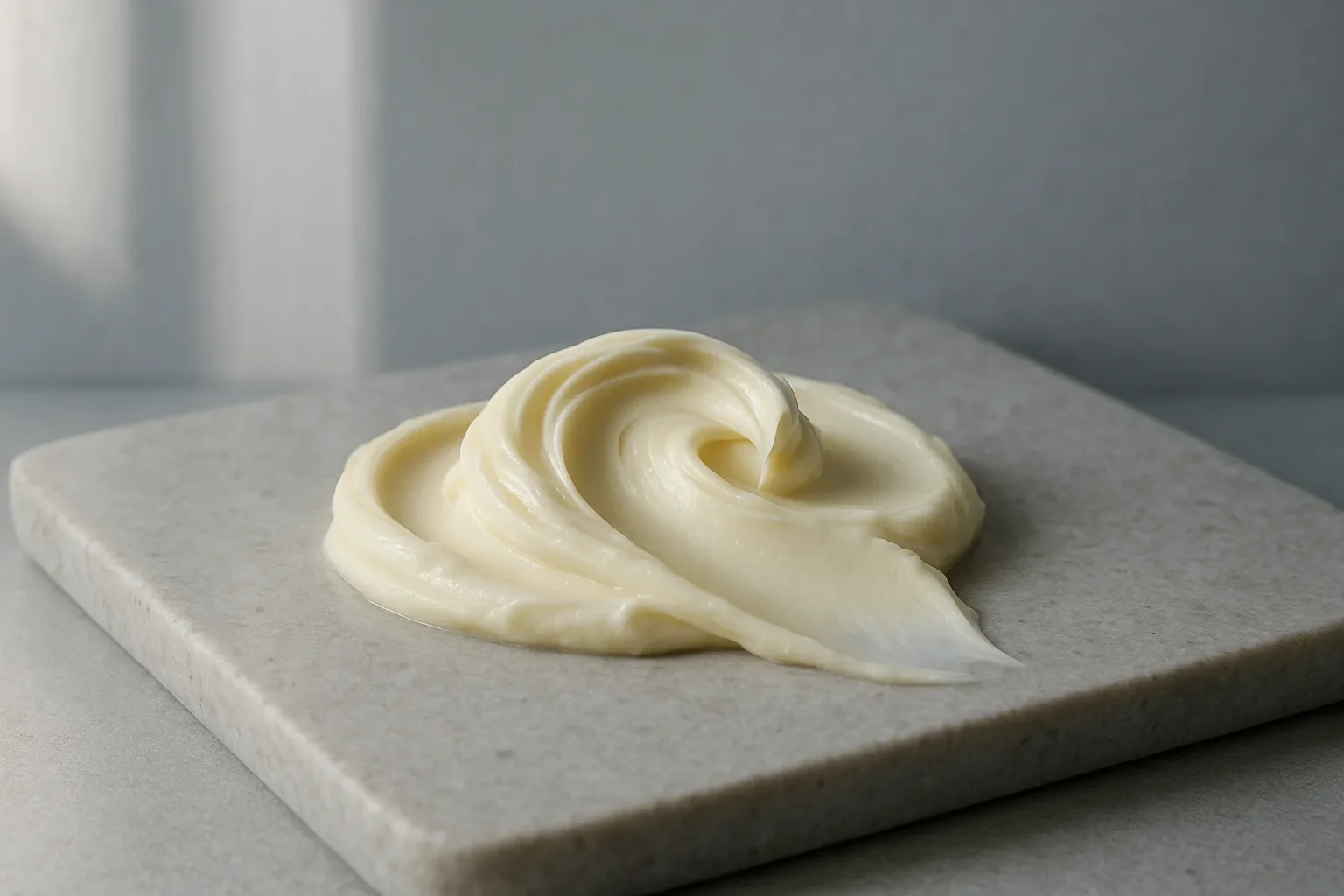
Simply seeing the phrase "cream containing shea butter" makes it hard to judge whether it suits your skin. Shea butter is a plant-based oil ingredient, and in ingredient list order, it's generally placed in the section that forms oiliness and texture. Rather than saying this single ingredient is good or bad, it's better to first structurally examine 'in what skin condition, and why, is it needed.'
- 1Moisture/Oil Base SectionCheck the basic framework of the formulation
- 2Barrier Lipid SectionCheck for ceramides and other lipid-series ingredients
- 3Soothing/Conditioning SectionCheck for panthenol, allantoin, etc.
- 4Functional Ingredient SectionCheck for approved functional ingredients and elasticity-care ingredients
The role shea butter plays for skin
Shea butter is classified as an oil ingredient that forms a film on the skin's surface to prevent moisture from evaporating. In other words, rather than directly supplying moisture, it functions more like a sealant that holds in the moisture already present on skin or the skincare ingredients applied beforehand, preventing them from evaporating.
Because of this role, shea butter is often included in creams rather than lotions, especially in rich-type formulations applied as the final step. However, for skin that finds oiliness heavy, the same ingredient may feel different depending on how it's experienced.
What skin conditions might benefit from it
If your skin shows noticeable dryness and still feels tight even after a light lotion, a cream containing an oil segment can help as a finishing step. This is also why formulas containing oil-based ingredients are often mentioned during seasonal transitions or when skin becomes rough and sensitive due to heating or air conditioning.
On the other hand, if you're sensitive to the feeling of oiliness itself or feel that you have high sebum production, it's hard to say that a product containing shea butter is automatically a good fit. In such cases, it's more practical to check where shea butter is listed alongside how lightweight the formula is designed to be.
What matters isn't simply whether shea butter is present, but which ingredients it's grouped together with. If lipid-type ingredients that support the skin barrier or ingredients for elasticity care are formulated alongside the oil segment, the oil can play a role beyond simple finishing.
| Skin condition | Perceived tendency | Points to check |
|---|---|---|
| Skin prone to dryness and tightness | An oil segment may help | Whether barrier lipids and moisturizing ingredients are included together |
| Skin sensitive to seasonal changes or heating/cooling | Consider increasing the proportion of finishing oil | Whether soothing ingredients are included |
| Skin sensitive to oiliness | Need a lightweight formula and adjusted amount | Listing order and formula design |
How to read shea butter's position in the ingredient list
The ingredient list is generally ordered by concentration, but below a certain concentration threshold, the listed order can shuffle. In other words, shea butter appearing later in the list doesn't mean it has no role — it's more accurate to read the list keeping in mind that low-concentration ingredients can have their order altered.
So rather than focusing on a single number or ranking, it's useful to develop the habit of reading the ingredient list in segments. Dividing it into a water/oil base segment, a barrier lipid segment, a soothing/conditioning segment, and a segment containing functional ingredients makes it clearer what role shea butter is actually playing.
How to use shea butter step by step
In a skincare routine, products containing shea butter usually come last. The approach is to first deliver moisture and active ingredients through a toner or ampoule, then finish by layering a cream containing oil ingredients on top.
During times when skin is especially dry or when seasons are changing, it can help to give slightly more weight to this final step. Conversely, during times when oiliness feels burdensome, it's more realistic to adjust by using less of the same product or applying it in a thinner layer.
To also address elasticity and wrinkles
However, oil ingredients like shea butter are focused on preventing moisture evaporation, so it's difficult to explain changes that accumulate over time, like elasticity or fine lines, with an oil ingredient alone. So when choosing a cream, it's more practical to check whether elasticity care or functional ingredients are formulated alongside the oil segment, rather than focusing on how much of the oil segment is included.
From this perspective, the habit of reading the ingredient list in segments helps you grasp the design intent of the entire cream, not just shea butter alone.
The final step — which cream should you finish with
The ARZTIN Regenerative Seat Cream is a case worth referencing from this perspective. Looking at the full ingredient list, alongside the emollient segment containing squalane, shea butter, and argan kernel oil, a barrier lipid segment including ceramide NP and cholesterol can be confirmed, along with a segment containing adenosine and 3 types of peptides, which serve as the basis for wrinkle-improvement functional cosmetics (approved). In other words, rather than a design that ends with emollients alone, one can approach it by examining whether the emollient, barrier, and elasticity care segments are woven together at the finishing stage. Results confirming improved skin elasticity recovery and cheek firmness immediately after use have been observed, but this is a result under specific test conditions and individual differences may occur.
사용 전과 비교해 사용 직후 통계적으로 유의하게 개선됐습니다. 개선율(%)은 사용 전 대비 변화량의 비율이며(|사용 후−사용 전|÷사용 전×100), 개인차가 있을 수 있습니다.
출처 P&K 피부임상연구센타 인체적용시험 결과보고서 (PNK-24610-RD1R2, 2024)
사용 전과 비교해 사용 직후 통계적으로 유의하게 개선됐습니다. 개선율(%)은 사용 전 대비 변화량의 비율이며(|사용 후−사용 전|÷사용 전×100), 개인차가 있을 수 있습니다.
출처 P&K 피부임상연구센타 인체적용시험 결과보고서 (PNK-24610-RD1R2, 2024)
Frequently asked questions
- If shea butter is listed at a low concentration, does that mean it has no effect?
- It's hard to say for certain. While ingredient lists are generally ordered by concentration, ingredients at lower concentrations can have varying listing order, so it's more accurate to look at which section it's designed into rather than judging its role by position alone.
- Can oily skin also use creams containing shea butter?
- If your skin is sensitive to oiliness or tends toward oily, what matters more than shea butter itself may be how light the formulation is and how you control the amount used. If breakouts persist after use, it's recommended to consult a dermatologist or similar specialist.
- Can shea butter alone manage elasticity or fine lines?
- Shea butter is an oil-based ingredient that helps prevent moisture from evaporating, and it's difficult for a single oil ingredient to address changes like elasticity or fine lines that build up over time. If you're considering these kinds of changes, it's more practical to look at products co-designed with elasticity-care ingredients.
- When during the day is best to apply shea butter cream?
- It's typically used as the final step of a skincare routine, sealing in the ingredients and moisture applied beforehand to prevent evaporation. During periods of severe dryness, you might place a bit more emphasis on it.
Related products
 리제너레이티브 실트 크림Buy
Anti-wrinkle functional cosmetic · A rich cream that addresses both elasticity and barrier care
- 리제너레이티브 실트 크림Buy
Anti-wrinkle functional cosmetic · A rich cream that addresses both elasticity and barrier care
- 리제너레이티브 실트 크림Buy
Anti-wrinkle functional cosmetic · A rich cream that addresses both elasticity and barrier care
- 리제너레이티브 실트 크림Buy
Anti-wrinkle functional cosmetic · A rich cream that addresses both elasticity and barrier care
- 리제너레이티브 실트 크림Buy
Anti-wrinkle functional cosmetic · A rich cream that addresses both elasticity and barrier care