
Criteria for Choosing Asiatic Acid: How to Properly Read Centella Asiatica-Derived Ingredients on Ingredient Lists
Asiatic acid is an ingredient derived from centella asiatica, and together with asiaticoside and madecassic acid, it is grouped as one of the three centella asiatica-derived ingredients used in skin-soothing care. Rather than just looking at this single ingredient on the ingredient list, the key is to check whether all three centella asiatica-derived ingredients are listed together, and whether the product is designed to also address elasticity and moisturizing. It's also important to keep in mind that ingredient order alone cannot definitively indicate concentration, as ingredients present in lower amounts may appear out of strict order.

When reading cosmetic ingredient lists, you often come across the name 'asiatic acid.' It's widely known to be an ingredient derived from centella asiatica, but exactly 'what criteria to use when choosing' often remains vague. This article organizes, from an ingredient formulation perspective, the context in which asiatic acid exists within an ingredient list, and what to check together when actually choosing a product.
Why shouldn't you look at asiatic acid 'alone'?
Asiatic acid is one of several triterpenoid ingredients isolated from centella asiatica extract. Centella asiatica-derived ingredients are usually found together as a set—asiaticoside, madecassic acid, and asiatic acid—because the centella asiatica extract itself contains multiple active ingredients together.
So rather than searching for asiatic acid alone on the ingredient list, checking whether all three of these ingredients are listed together becomes a more meaningful criterion. Whether only one is included alone, or all three are formulated together, can serve as a clue to how the product handles centella asiatica-derived ingredients.
What ingredient list order does and doesn't tell you
There's a principle that cosmetic ingredient lists are ordered by descending concentration, but ingredients present in lower amounts may not strictly follow this order. In other words, being listed earlier doesn't always mean a higher concentration, and ingredients like Centella asiatica-derived components, which are often used in relatively small amounts, are commonly found toward the end of the ingredient list.
Therefore, rather than making simple judgments like 'listed early, so it's a good product' or 'listed late, so it's lacking,' it's more practical to check whether all three Centella asiatica-derived ingredients are present together, and how they're positioned within the overall formulation design alongside other functional groups (soothing, barrier, moisturizing, elasticity).
Points to check differently depending on skin condition
During periods when skin is sensitive or temporary redness is a concern, it's best to first check whether Centella asiatica-derived ingredients are formulated for soothing care. On the other hand, if fine lines or reduced elasticity are also a concern, you should check whether wrinkle-improvement functional ingredients like adenosine or peptides are formulated alongside the Centella asiatica-derived ingredients, rather than relying on them alone.
During periods of dryness and tightness, it's also worth checking whether barrier lipids such as ceramides and cholesterol, or oils such as squalane and shea butter, are included alongside Centella asiatica-derived ingredients. Even if Centella asiatica-derived ingredients help with soothing, moisture retention may not be sufficient without support from barrier lipids and oils.
| Main concern | Ingredient groups to check alongside Centella asiatica-derived ingredients |
|---|---|
| Sensitivity/redness | Three Centella asiatica-derived ingredients (whether formulated for soothing purposes) |
| Fine lines/reduced elasticity | Adenosine, three types of peptides |
| Dryness/tightness | Barrier lipids such as ceramides and cholesterol, oils such as squalane and shea butter |
Selection criteria organized step by step
First, rather than checking only for asiatic acid alone in the ingredient list, first confirm whether all three Centella asiatica-derived ingredients (asiaticoside, madecassic acid, asiatic acid) are listed together.
Second, don't assume concentration based solely on listing order. Keep in mind that even ingredients positioned later may not necessarily be present in low amounts, as ordering can vary for lower-concentration ingredients.
Third, depending on whether your main concern is soothing, elasticity/wrinkles, or dryness/barrier, check what ingredient groups are combined alongside the Centella asiatica-derived ingredients.
Fourth, depending on the formulation type (lotion, cream, rich cream, etc.), it's also worth considering how long the Centella asiatica-derived ingredients can stay on the skin together with other moisturizing and oil ingredients.
How to view Centella asiatica-derived ingredients in the context of elasticity and wrinkle care
Centella asiatica-derived ingredients are a class of ingredients long used for soothing care, but if elasticity or wrinkles are also a concern, formulation isn't complete with these ingredients alone. In such cases, a practical selection criterion is to check whether wrinkle-improvement functional ingredients like adenosine, or elasticity-care ingredients like peptides, are also present in the ingredient list alongside the Centella asiatica-derived ingredients.
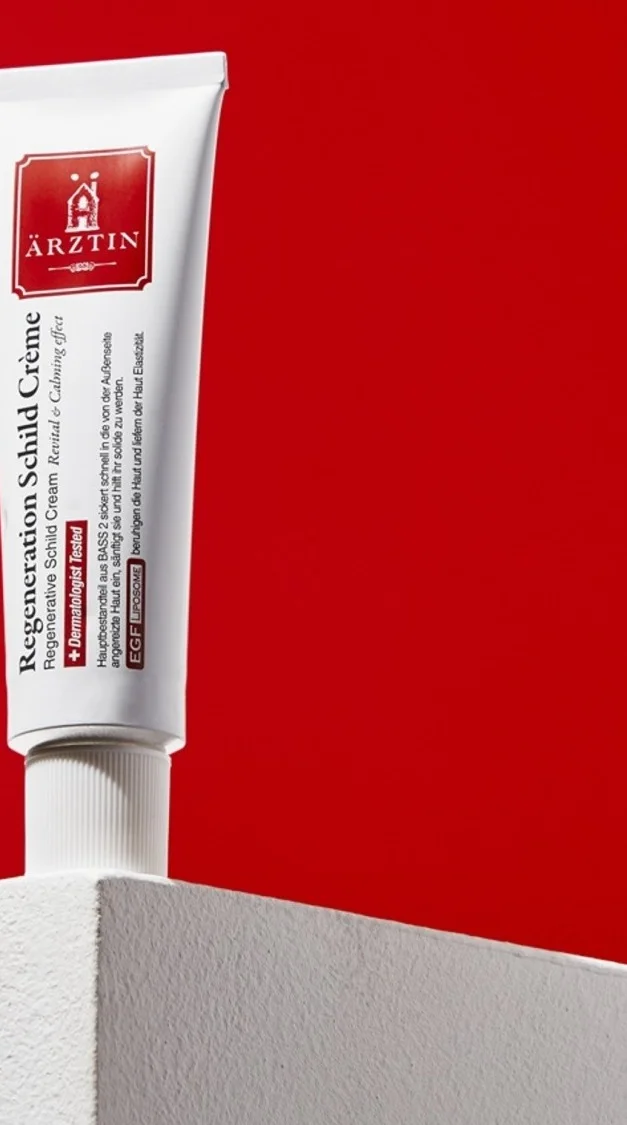
ARZTIN Regenerative Sit Cream is a product certified as a functional cosmetic for wrinkle improvement. Its full ingredient list confirms adenosine, a notified functional ingredient, alongside three types of peptides (sh-Oligopeptide-1, rh-Oligopeptide-2, rh-Polypeptide-1), three Centella asiatica-derived ingredients (asiaticoside, madecassic acid, asiatic acid), barrier lipid ingredients such as ceramide NP, cholesterol, and palmitic acid, and oils such as squalane, shea butter, and argan kernel oil. It is one example worth referencing when examining an ingredient list designed to address both elasticity/wrinkle care and soothing/barrier care together.
The final step: which cream should you finish with?
When choosing a Centella asiatica-derived ingredient, rather than stopping at just checking for 'soothing,' forming the habit of checking whether elasticity and wrinkle care are also designed in can become a practical standard for reading an ingredient list. ARZTIN Sit Cream is a wrinkle-improvement functional cosmetic with an ingredient composition worth referencing from this perspective.
사용 전과 비교해 사용 직후 통계적으로 유의하게 개선됐습니다. 개선율(%)은 사용 전 대비 변화량의 비율이며(|사용 후−사용 전|÷사용 전×100), 개인차가 있을 수 있습니다.
출처 P&K 피부임상연구센타 인체적용시험 결과보고서 (PNK-24610-RD1R2, 2024)
사용 전과 비교해 2주 사용 후 통계적으로 유의하게 개선됐습니다. 개선율(%)은 사용 전 대비 변화량의 비율이며(|사용 후−사용 전|÷사용 전×100), 개인차가 있을 수 있습니다.
출처 P&K 피부임상연구센타 인체적용시험 결과보고서 (PNK-24610-RD1R2, 2024)
Frequently asked questions
- Are asiatic acid and madecassic acid the same ingredient?
- Both are derived from centella asiatica, but they are different ingredients. Asiaticoside, madecassic acid, and asiatic acid are the three representative ingredients commonly found together in centella asiatica extract, often grouped and referred to as the three centella asiatica-derived ingredients.
- Does an ingredient's position near the end of the ingredient list mean it has no effect?
- That cannot be assumed. While cosmetic ingredient lists are generally arranged in order of concentration, there is a principle that ingredients present in lower amounts may appear out of strict order, making it difficult to judge concentration or effect based on position alone.
- Is a product with only centella asiatica-derived ingredients sufficient for elasticity care as well?
- Centella asiatica-derived ingredients are known as an ingredient category that can help with skin-soothing care, but if elasticity or wrinkles are also a concern, it's advisable to check whether functional ingredients approved for such claims, like adenosine, or peptides are also included in the formulation.
- What should I do if I feel irritation while using centella asiatica-derived ingredients?
- Reactions to ingredients can vary from person to person. It is recommended to discontinue use and consult a dermatologist or other specialist if symptoms persist.
Related products
 리제너레이티브 실트 크림Buy
Anti-wrinkle functional cosmetic · A rich cream that addresses both elasticity and barrier care
- 리제너레이티브 실트 크림Buy
Anti-wrinkle functional cosmetic · A rich cream that addresses both elasticity and barrier care
- 리제너레이티브 실트 크림Buy
Anti-wrinkle functional cosmetic · A rich cream that addresses both elasticity and barrier care
- 리제너레이티브 실트 크림Buy
Anti-wrinkle functional cosmetic · A rich cream that addresses both elasticity and barrier care
- 리제너레이티브 실트 크림Buy
Anti-wrinkle functional cosmetic · A rich cream that addresses both elasticity and barrier care